
Subtle Foreshadowing: How the Internet Consumed Us
The speculative fiction of the future is now our reality. How do we reclaim ourselves in a hyper-real world?

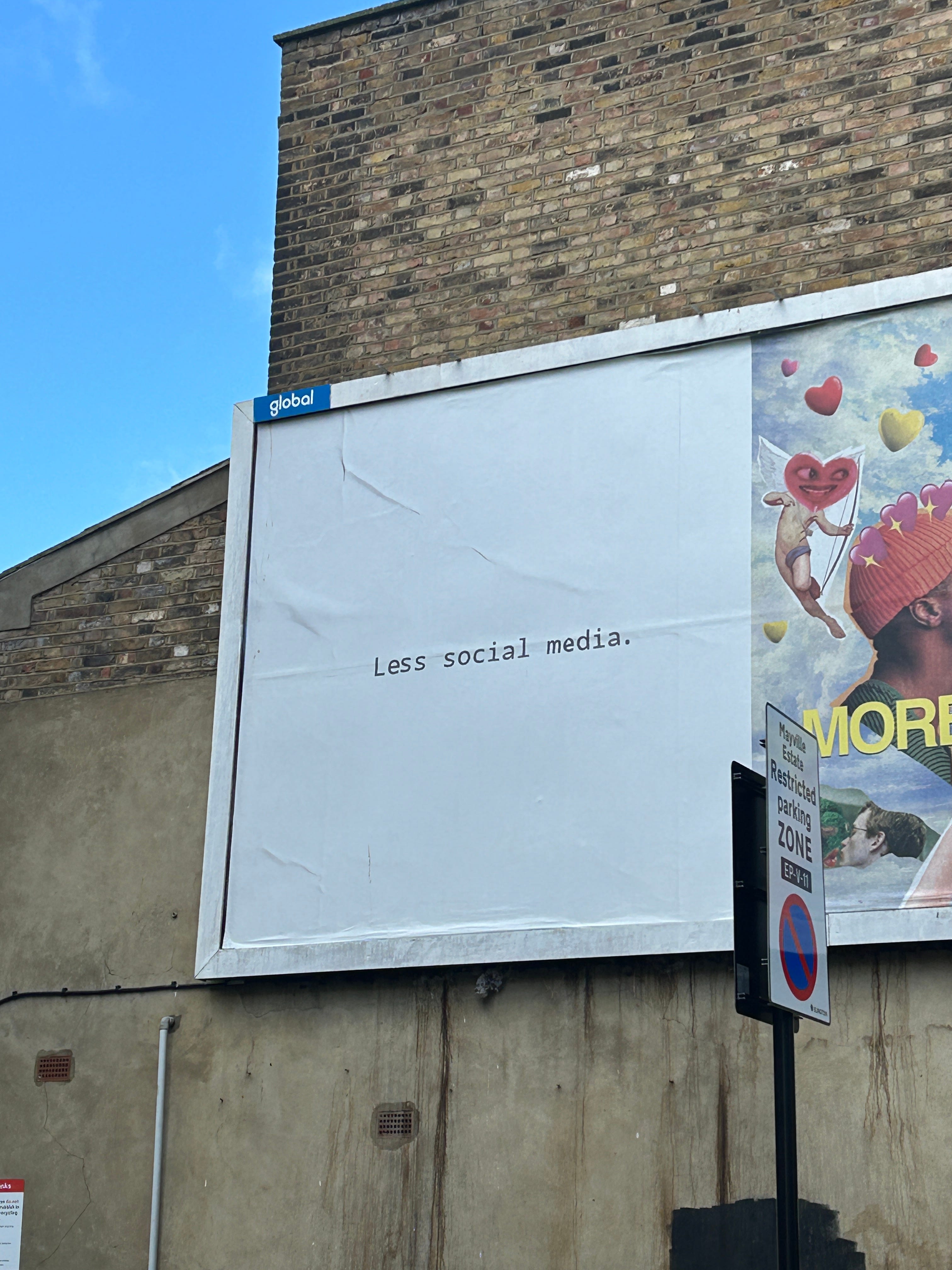
I am sitting in a members club with wine-coloured velvet chairs and low heating. There’s a draft coming from the window, and I find myself annoyed that I need to wear a winter hat indoors. I have nowhere to be so I am here, scrolling aimlessly, wondering what I’m searching for. Increasingly, my phone feels like the last place I want to be. I didn’t move to London to sit and stare at a screen all day from Shoreditch House. Yet here I am. Scrolling and reading think piece after think piece about the current state of the Internet.
My relationship with the Internet has always been complicated. Growing up, I felt disconnected from the cultures I was born into and surrounded by, so the Internet became my culture. It was my escape, my portal, and my community. Throughout my career, I’ve called myself a “lifelong lover of the Internet,” but recently, I’ve started to wonder if that love has soured—or if it was ever real at all.
Last night, my phone was at 5%, and I asked the bartender to charge it. I briefly thought about what would happen if I lost it or if it were stolen. The thought made me nauseous and reminded me I was unprepared to deal with that reality. I went to retrieve it only at 19%, surprising the bartender and myself. I clutched it tightly, knowing that was enough of a battery to sit through a jazz show and Lime bike home. How did this small device come to feel so essential, so entwined with my sense of self and safety?
Since moving to London, my relationship with my phone has only grown more complicated. It’s no longer just a tool; it’s become a connection surrogate. When I feel lonely, I find myself flicking between apps and contacts, sending a thirsty little “hey” into the void to soothe the ache. My mind feels both full and blank. The truth is, I feel lost. The confidence I had while building a life in a new city seems to have evaporated with the changing seasons. And every day, the question—What am I doing here?—feels more existential as I look deeply into the black box.
Subtle Foreshadowing: A Meta-Narrative
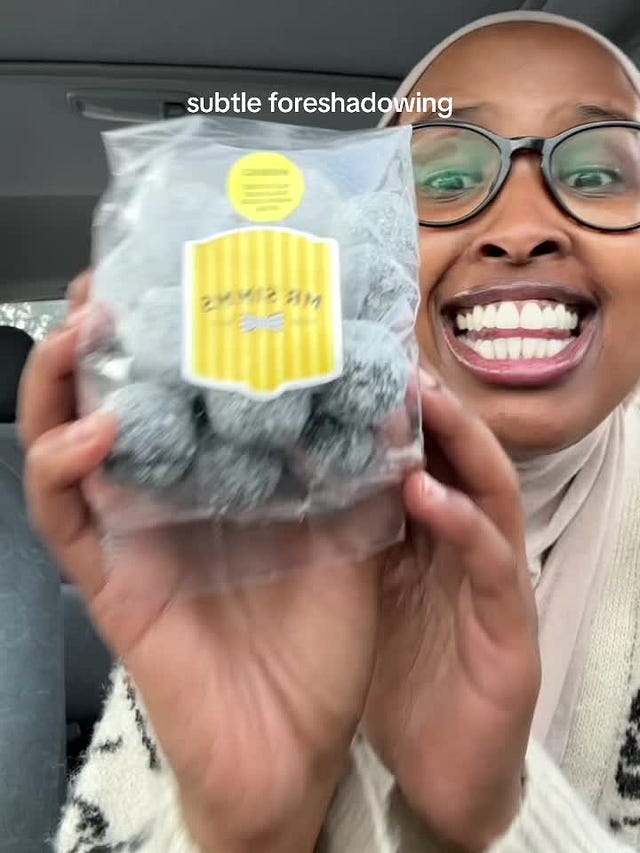
I haven’t stopped thinking about the most recent trend on my FYP though, “subtle foreshadowing.” The chaotic editing feels both disjointed and deeply familiar—revealing the hook and climax before the rising action, a story told in reverse. It’s entertaining, sure, but it also feels like its own meta-narrative—a reflection of our over-consumed, over-stimulated minds. We’re so addicted to novelty, that we’ve restructured storytelling to satisfy our short attention spans. What’s fascinating is how the trend mimics the way our minds now process information: fragmented, hyper-linear, and always searching for the dopamine hit of the “big reveal.” The “subtle foreshadowing” format doesn’t leave room for subtlety at all—it’s designed to grab attention in a matter of seconds. It’s storytelling for a distracted, anxious audience.
 Tiktok failed to load.
Enable 3rd party cookies or use another browser
The trend speaks to something bigger: how the Internet has reshaped not just our media consumption but our very expectations of reality. It mirrors the feedback loops we live in, where context is stripped away and every moment is reduced to its flashiest, most digestible parts. But what happens when we start thinking of our lives in this way? When we live as though we need to produce our own hooks and climaxes, skipping over the slower, quieter, less glamorous moments that make up the bulk of real life?
 Tiktok failed to load.
Enable 3rd party cookies or use another browser
In a way, the trend feels like a kind of digital exhaustion manifesting as creativity. We’re trying to entertain ourselves, sure, but we’re also signaling how bored and overstimulated we’ve become—how much we need to disrupt the monotony of the scroll. It’s chaotic, yes, but the chaos feels familiar, like a cry for something deeper, something more.
The Internet as a Mirror, Not a Window
We once believed that the Internet’s promise was a world connected—a window into the infinite. Instead, it became a mirror, reflecting not the truth but our desires, biases, and insecurities. It’s a source of disconnection, where the promise of seeing the world has been replaced by a relentless feedback loop of seeing ourselves—branded, algorithmically curated, and perpetually unsatisfied. We’ve grown bad at looking beyond the mirror. We are divided in perspective and unable to share space. The literal concept of a “third space” has become a branded place with a membership fee.
For most of my life, the Internet was my haven and as my access to it evolved, my phone became integral to my social health and career. I’ve spent years studying and celebrating online culture. But recently, I’ve struggled to stay committed to the bit. Episodes of my podcast Send Me the Link feel more like a quiet reckoning with our digital lives—a curious look at "How did we get here?" and "Do we even like this?"—from two people who once truly loved the World Wide Web. I told myself it was fine to shift, to use this Substack as a place to experiment and play. But the truth is, I don’t feel playful anymore. The Internet was always about escapism for me, and now I want to escape from it.
I decided to take an indefinite break from X (though I haven’t properly deleted it). The only BlueSky I want to be looking at is the one outside. I’ve been consuming less, but even in my limited scrolls, I find myself muttering, What am I looking at? A member of MomTok dances to a 2000s rap song. Rebecca Black rehearses choreography, interrupted by JoJo Siwa. These moments are fleeting and trivial, yet they stick to me like lint—proof that the media isn’t just something we consume; it consumes us.
A few weeks ago, I went to listen to an album at Devon Turnbull's Hi-Fi Listening Room. It reminded me how rare it is to engage with the world without a digital lens—and how the Internet haunts even our offline moments. I took myself to a coffee shop after to reflect and write in my journal. I found myself in the middle of multiple people’s social content, confronted with the final girlbosses of Instagram.
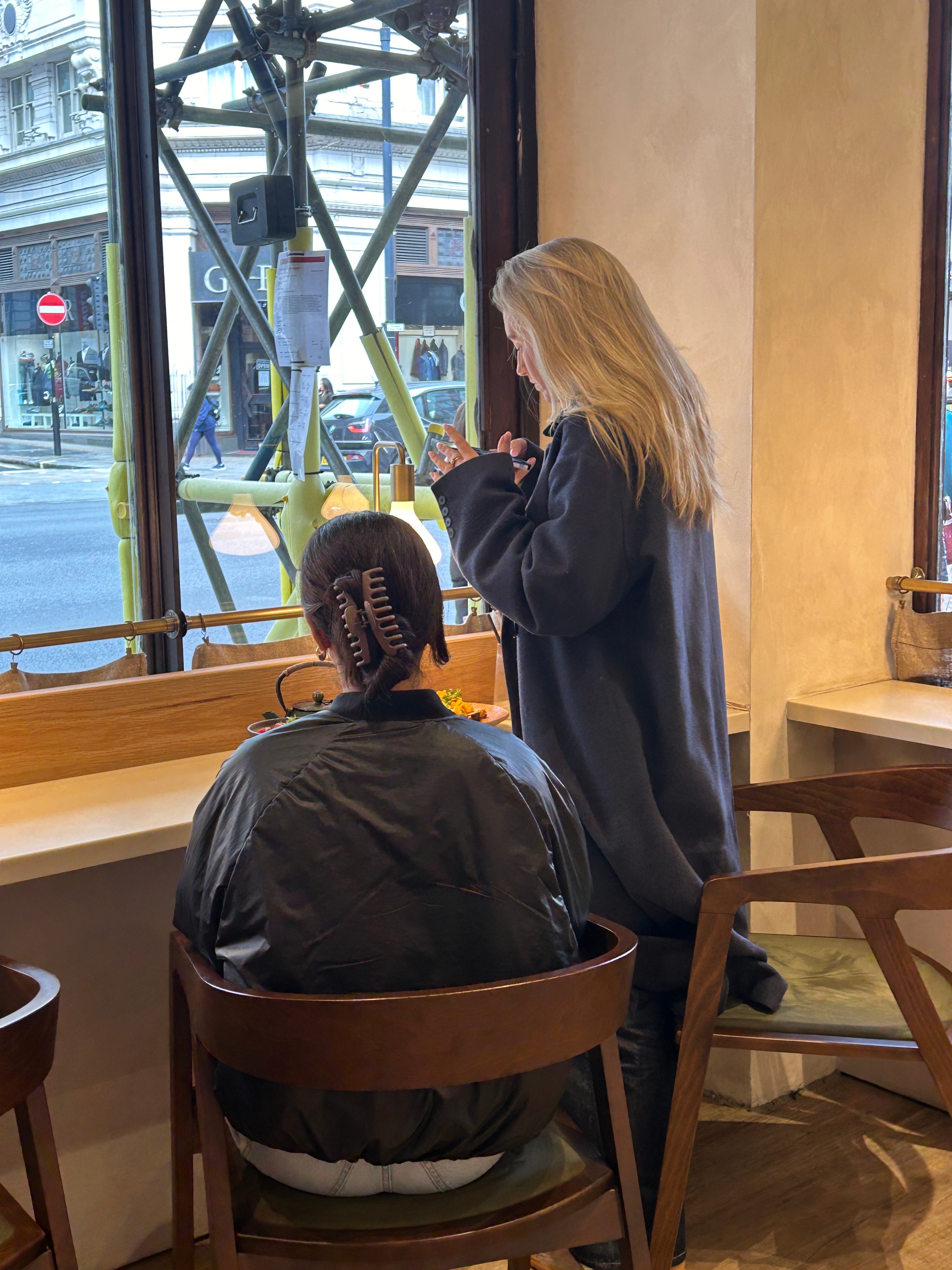
Without judgment, each pair felt like a humanization of a corner of the Internet. I could, by trade, smell their influences, picture their mood boards, their saved folders, their algorithms. One pair sent their food back for being cold—perhaps because it sat too long for the photo. The second took her time snapping flatlays of Hailey Bieber’s Rhode Lipgloss, perfectly pairing her coffee with a product still in its box. Watching it, I wondered: Who is this for? Herself? Her feed? Who, or what, is she feeding? How did our leisure time become dedicated to promoting ourselves and the brands we consume? This is hyper-reality in real life.
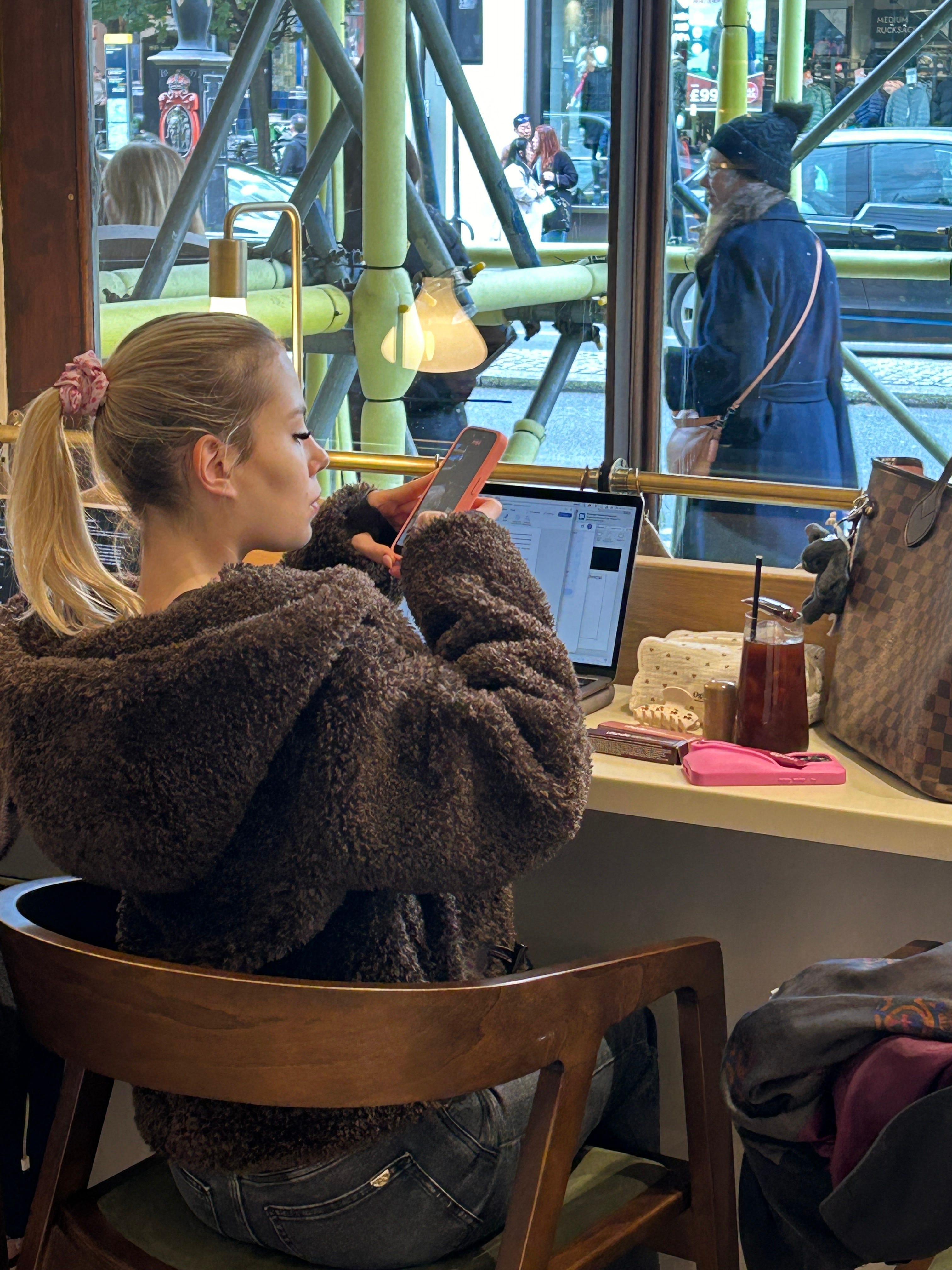
In moments like this, I wonder: When are we going to take the Internet’s omnipresence seriously? Its very existence was rooted in military weaponry. Why are we surprised that it now programs our perspectives and worldviews? We believed the Internet could deliver connection, truth, and meaning. Instead, it reflects curated, commodified realities that deepen disconnection—from ourselves and each other. The Internet has become a substitute for many things: community, identity, purpose, connection, and even spirituality. For some, it has acted as a modern-day church, offering a space where people seek meaning, validation, and answers. The Internet cannot be your church if you no longer believe in God. It cannot fulfill the role of offering solace, inspiration, or a deeper sense of self. Without belief, the Internet becomes just another tool—functional but ultimately empty.
Where Do We Go From Here?
One of my favorite Substack writers, Kyle Raymond Fitzpatrick wrote, “social media and tech isn’t just killing itself but it has killed us.” The Internet Archive is being deleted, and we’re losing our digital history, so what does this mean for our digital futures? Maybe the revolution isn’t in logging off entirely but in curating something else.
If the Internet has become a mirror reflecting commodified realities, the challenge now is learning how to turn away—to rediscover the world and ourselves without its distortions. Constant connectivity detracts from meaningful, real-world interactions and self-reflection but is also my current lifeline. We need spaces where the digital world doesn’t intrude, where connection feels tactile and true. If the Internet is a mirror, it’s time to look away and rediscover what lies beyond our reflection. Send me things that nourish the mind and soul, and help end the infinite scroll.
Always yours, but increasingly less online,
Mel

🔗 Things I’ve enjoyed consuming lately:
"Lost In The Future" by Ed Zitron: Zitron reflects on the aftermath of the November 5 elections, expressing a sense of powerlessness and frustration. He critiques the legacy media's attachment to objectivity and its failure to address issues like corporate price gouging and economic inequality.

“RIP Social Media 2004–2023" by Kyle Fitzpatrick”: This piece reflects on the evolution and eventual decline of social media over nearly two decades. Fitzpatrick explores how platforms that once promised connection and community have become dominated by commercialization, misinformation, and superficiality.

In this interview, Matt Klein converses with media theorist Douglas Rushkoff to mark the 15th anniversary of Rushkoff's seminal work, Program or Be Programmed. Rushkoff emphasizes the importance of human agency in the digital age, advocating for a conscious approach to technology that prioritizes human values over algorithmic determinism.

Catherine Shannon explores the impact of smartphone usage on personal well-being and self-perception. She discusses how constant engagement with digital devices can lead to stress, anxiety, and a diminished sense of self-worth, ultimately affecting one's confidence and sensuality.
Zadie Smith discusses the pervasive influence of algorithms and smartphones on our lives. She expresses concern about how these technologies shape our perceptions and behaviors, often without our conscious awareness.