
001: Left on Read
On unread messages, digital guilt, and the new etiquette of being unavailable

The other day, a colleague asked if they could follow my Substack. I laughed, not because of their thoughtfulness but because this space has been inactive all year. I didn’t know how to explain if it was still “a thing” I was doing. For the past nine months I’ve been thinking more about writing than actually putting any thoughts down.
I built a career and this corner of the world wide web with intention and vision, then abandoned it. Part of it was fatigue, part of it was a changing relationship to the Internet, all in all an attempt to heal my chronically onlineness.
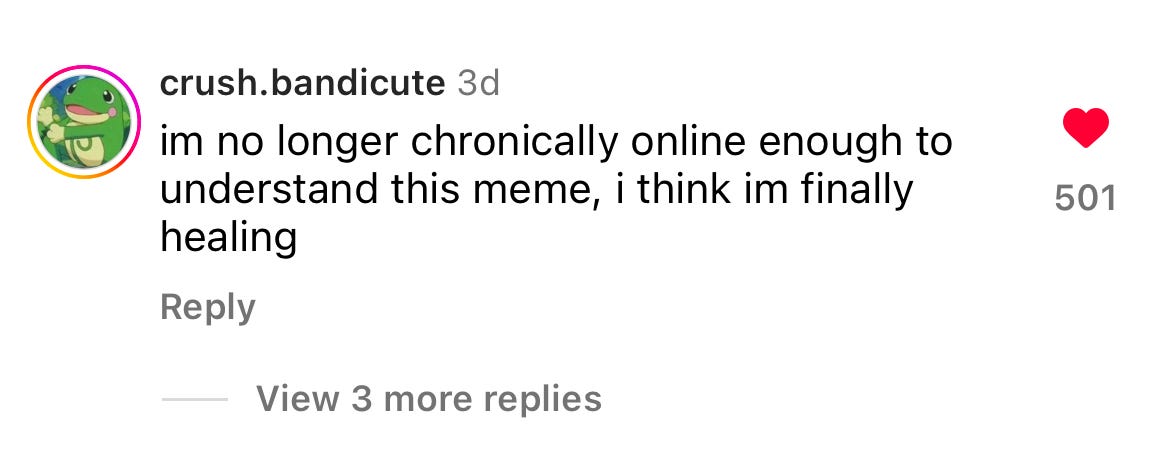
Healing, though, has made me a terrible correspondent. If you’re reading this, chances are you’ve written me and I haven’t gotten back to you, and I am truly sorry. Right now I have about 45 minutes worth of unheard voice notes waiting for me on my phone, jammed between WhatsApp threads, iMessages, and Instagram DMs. My messaging apps have become archaeological digs of good intentions. I open them, scan the previews, mentally draft responses… and then nothing. It feels like the digital equivalent of standing at the edge of a pool, taking a deep breath, and never diving in, because I don’t feel like getting wet or being in the water.
My people have adapted in various ways. My cousin has developed a strategy of texting herself back into relevance when she needs me, a digital version of waving both arms in my face. “Bumping myself back to the top,” she’ll write, three days after sending a frenzy of full-screen texts.
, who once described our friendship as “digital roommates” split between Barcelona, London and Toronto, hasn’t heard from me in weeks (I am so sorry, babes). So many of my replies now begin with “I’m so sorry it’s taken me forever to respond.” Everyone seems understanding for the most part, getting the shorthand for “I care about you but cannot perform digital intimacy right now.”
This wasn’t always me. During those first pandemic months, when time stretched and presence became precious, I treated every notification like a lifeline. I wrote back like I was writing love letters. I sent seven-minute voice notes, musings about womanhood or updates on whatever chaos I’d gotten myself into, and my friends did the same. We listened to each other while pacing our apartments, folding laundry, trying to make human connection materialise through AirPods. Those messages were a counterbalance in a time when physical presence had become dangerous and unavailable.
The pandemic is long gone, but something fundamental has shifted in me lately. Each morning now brings another notification about collapse: wars, shootings, extreme weather, systems breaking down. My feed is an assembly line of despair. At the same time, my new job requires eight hours a day of Slack performance, which leaves me energetically bankrupt by 6 p.m BST. If I can push myself, that means a quick call with one of my grandmothers or FaceTime with my nephew, but after that I have nothing left. The thought of opening WhatsApp feels like contemplating a swim across the English Channel. Instead, I’ve updated my status to 🫶 slow to respond 🫶, in hopes it would buy me some time and that those who get it, get it, and those who don’t, will… eventually get over it ❤️🩹
Research from the American Psychological Association shows that the mere expectation of constant availability raises cortisol levels. So maybe my communication triage isn’t a moral failure, but adaptation, a means of survival, the digital equivalent of growing thicker skin. Still, the guilt lingers.
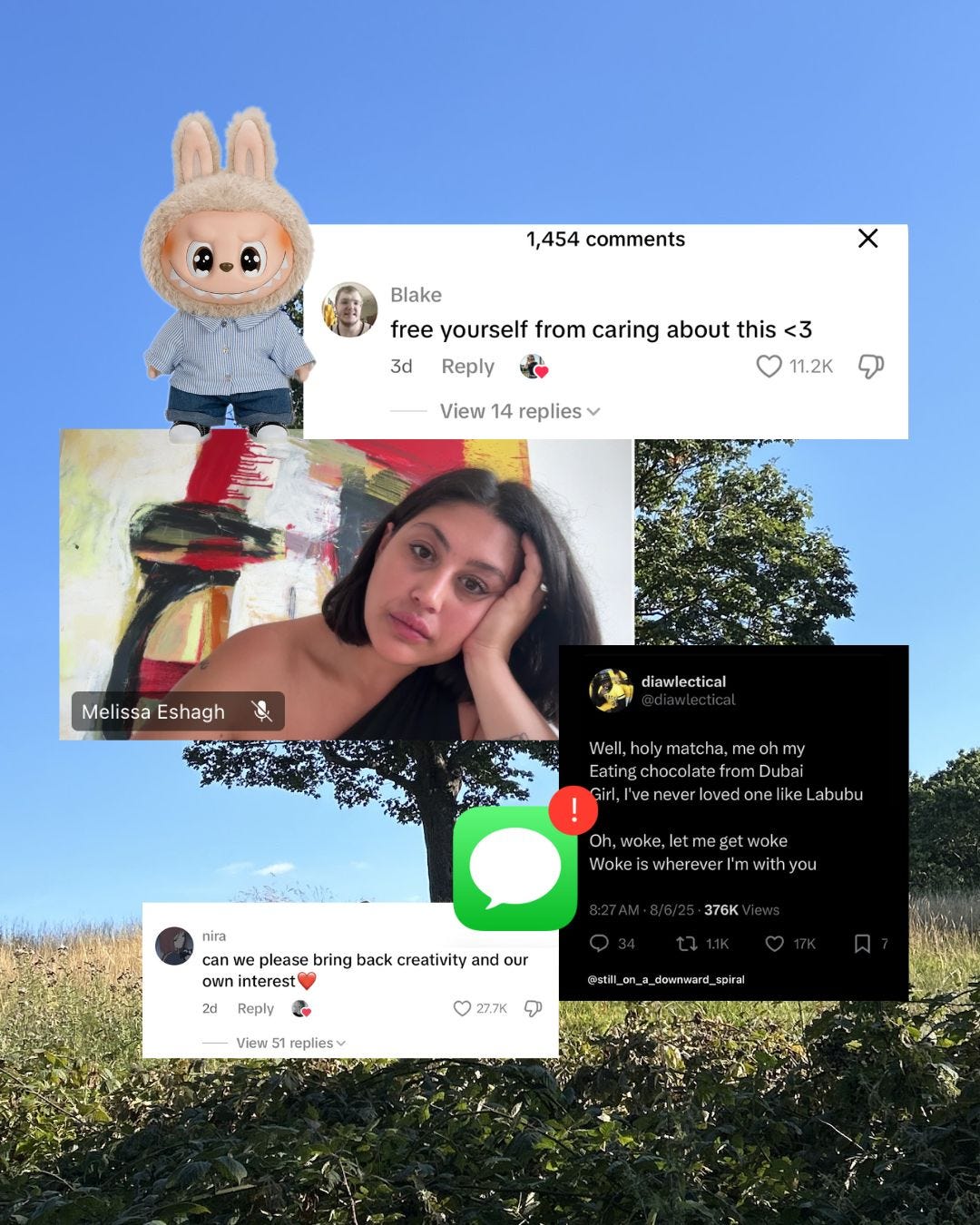
As a result, I’ve also noticed my screen time shrinking. That should be a good thing, right? And maybe it is: fewer hours of doomscrolling, slightly less mental erosion. My online life has contracted, but it hasn’t disappeared. I’m still online enough to chase a TikTok algorithm that never seems to nourish me but I understand most memes less and less and that brings me both joy and inner peace.

Catching me online these days is like bumping into me in a hallway: you’ll get a nod, a smile, maybe a shared TikTok with the caption “thinking of you x.”
I’m not writing digital love letters anymore, not recording voice note monologues. Just passing glances, quick acknowledgments that we exist in the same digital space. I’m hoping the weight of my double tap on Instagram comes across as “I’m not ignoring you.” It’s not the same as a message back but it is all I have right now.
I don’t have a tidy conclusion, no five-step plan for better digital citizenship. I don’t know if this is just a season or if it marks a permanent shift in how I’ll communicate going forward. But I do know this: if you’ve messaged me and I haven’t replied, I will eventually. I built this “hallway” brick by brick, and seeing your name on my screen still brings me joy, even if my digital social bandwidth is limited these days. Not every message gets the reply it deserves, but none of them disappear for me. They live in the queue, waiting for when I have the air to breathe and greet them, to write you back, and tell you how much I love and miss you.
Hey, at least I’m writing here again.
xx

🌀 In My Tabs Lately:
Social Media Is the Worst Place to Be Right Now: A powerful Vox essay by Adam Clark Estes, exploring how the Charlie Kirk shooting video spread like wildfire online, how graphic violence is no longer something we stumble upon, but something the algorithms bury us in.
VICE is Broke: A documentary directed by Eddie Huang, tracing the rise and fall of Vice Media (even I interned there): from its counterculture, punk-magazine beginnings in the 1990s Montreal, through its explosive growth into a multimedia empire.
Really Good Exposure: Megan Prescott’s (of Skins fame) debut show, a sharp, raw exploration of fame, shame, and survival in entertainment culture. It left me in tears.
Massive Attack Turns Live Facial Recognition Into Concert Commentary on Surveillance": At a recent show by Massive Attack, the band projected live video of the crowd using facial recognition, overlaying audience members’ faces in real-time with cryptic text, job titles, or other labels. It’s both art and provocation: a live reflection of the tech we’re increasingly subjected to, whether we consent or not.
still my fave digital roommate <333